
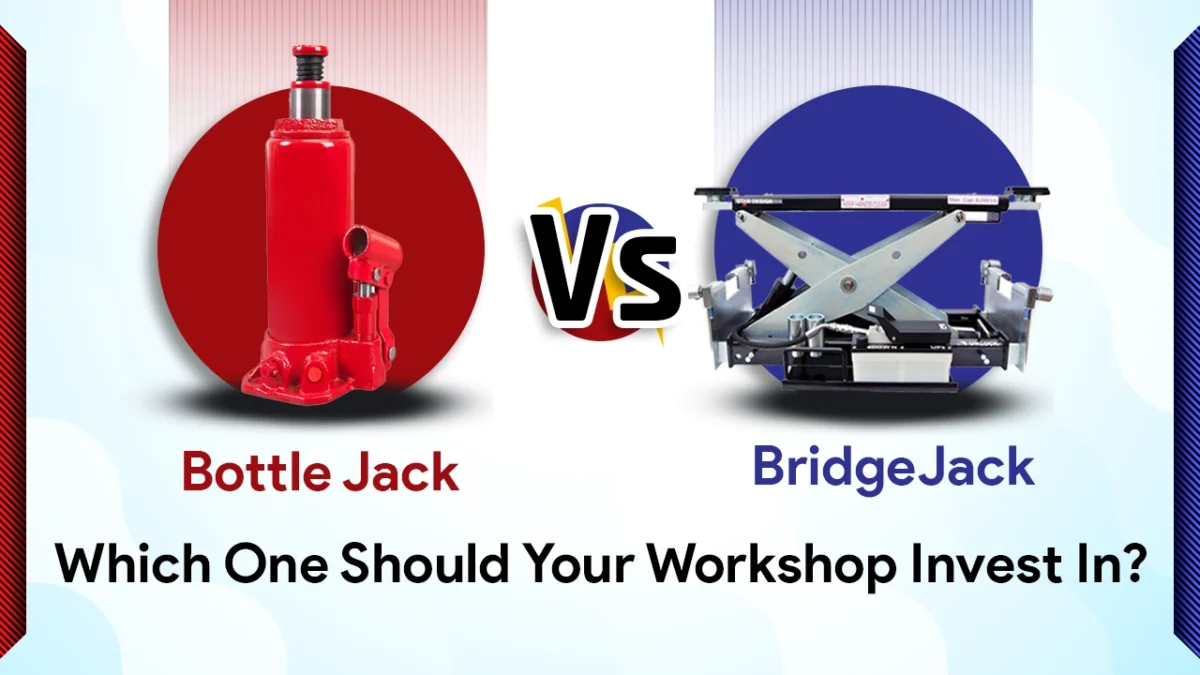
If you’re setting up or upgrading your workshop, one question often comes up: Should you invest in a bridge jack or a bottle jack?
Both are widely used in automotive repair, but they serve very different purposes. Choosing the right one can affect your workflow, safety, and overall efficiency.
Let’s break it down in a practical way so you can decide what fits your workshop best.
What Is a Bridge Jack?
A bridge jack (also known as a rolling jack) is designed to work with a 4-post lift. It sits between the runways and allows you to lift the vehicle’s wheels off the platform.
This makes it ideal for:
- Brake jobs
- Tire rotations
- Suspension work
- Wheel alignment prep
In most professional workshops, bridge jacks are part of a more permanent setup.
What Is a Bottle Jack?
A bottle jack is a compact hydraulic jack shaped like a cylinder. It’s simple, powerful, and easy to move around.
Bottle jacks are commonly used for:
- Lifting one side or axle of a vehicle
- Roadside repairs
- Quick workshop jobs
- Heavy-duty lifting in tight spaces
They don’t require a lift system, which makes them very versatile.
Key Differences at a Glance
| Feature | Bridge Jack | Bottle Jack |
|---|---|---|
| Setup | Works with 4-post lift | Standalone |
| Mobility | Fixed on lift | Portable |
| Best Use | Workshop operations | Flexible use |
| Speed | Faster in workflow | Manual operation |
| Investment | Higher cost | Budget-friendly |
When a Bridge Jack Makes Sense
If your workshop already has a 4-post lift, a bridge jack can be a big upgrade.
Better Workflow
You can lift the vehicle and work on wheels without moving it around.
Time-Saving
Everything happens in one place, which speeds up jobs – especially in busy shops.
Professional Setup
Bridge jacks are commonly used in high-volume service centers where efficiency matters.
Ideal for Repeat Jobs
If you’re doing the same type of work every day, this setup makes things smoother and faster.
When a Bottle Jack Is the Better Choice
Bottle jacks shine in situations where flexibility is more important.
Easy to Move Around
You can use them anywhere in the shop – or even outside.
Lower Cost
They’re much more affordable, making them great for smaller workshops or startups.
Strong Lifting Power
Despite their size, bottle jacks can handle heavy loads, including truck jacks for commercial vehicles.
Great for Occasional Use
If you don’t need to lift vehicles constantly, a bottle jack gets the job done without a big investment.
What About Safety?
Both types can be safe – but only when used properly.
- Bridge jacks offer better load stability because they’re integrated with lifts
- Bottle jacks require careful positioning and always need jack stands
No matter what you choose, safety practices matter more than the tool itself.
Cost vs Long-Term Value
This is where your decision really depends on your business.
Bridge Jack
- Higher upfront cost
- Better long-term efficiency
- Ideal for growing workshops
Bottle Jack
- Low initial investment
- Flexible use
- Best for smaller operations
So, Which One Should You Choose?
There’s no one-size-fits-all answer – it depends on how your workshop operates.
- If you run a busy workshop with a 4-post lift, a bridge jack is worth the investment
- If you need flexibility and lower cost, a bottle jack is a practical option
Many workshops actually use both – bridge jacks for daily work and bottle jacks for quick or mobile tasks.
Conclusion
Bridge jacks and bottle jacks both have their place in a workshop. The right choice depends on your setup, workload, and budget.
If efficiency and workflow matter most, a bridge jack is the better long-term investment. If flexibility and affordability are your priority, a bottle jack is hard to beat.
For workshops looking to upgrade their lifting equipment, choosing reliable solutions from manufacturers like Stan Design ensures better performance, durability, and safety in everyday operations.