
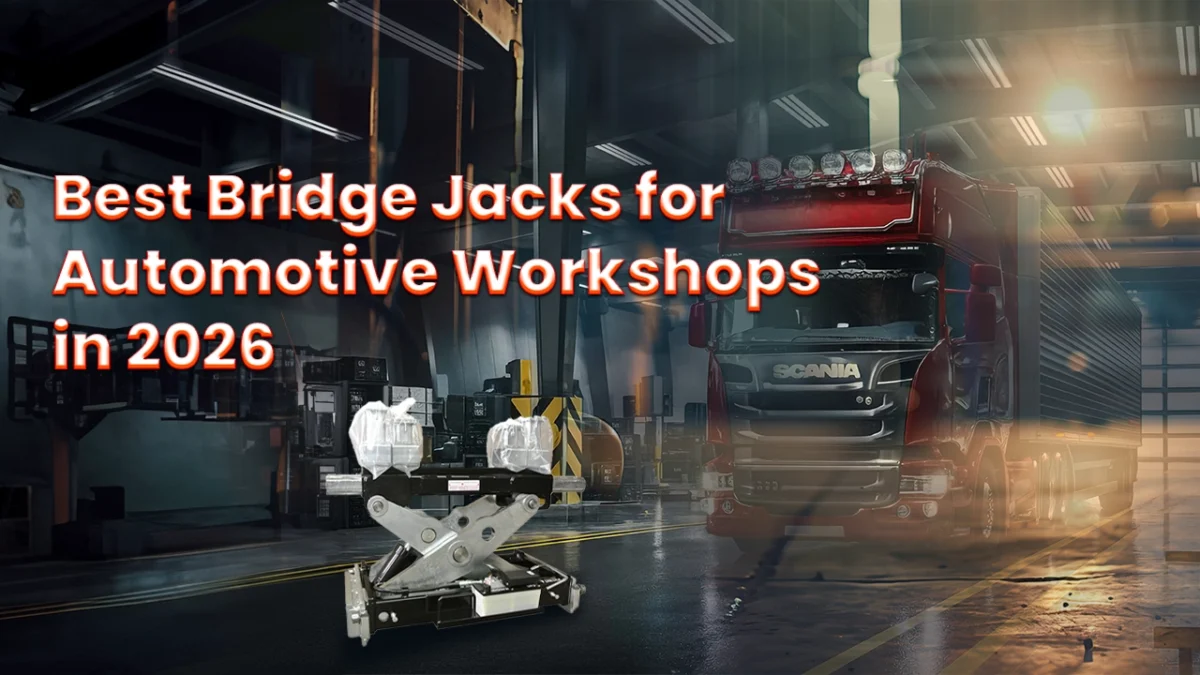
By 2026 your 4 post lift will no longer be enough. As Workshops expand and become more efficient the industry is moving towards increased productivity and efficiency when lifting and service of wheels, suspension components and aligning vehicles.
When lifting between two girders you would normally require bridge jacks, however many people find these useful to move around the workshop. In some cases you may find a truck jack is used for the heavier work and can be pushed or towed around the workshop by a jack truck.
Why Bridge Jacks Are Essential in Modern Workshops
The bridge jack is a component used on four post lift units to lift vehicle wheels off of the bridge rungs during service, maintenance and repair.
That means you can:
- Perform brake and suspension work
- Handle tire changes and alignments
- Access undercarriage components easily
The bridge jack is a great add-on for your shop that greatly increases the lift capability and versatility of your bridge plasma table.
Top Bridge Jacks for 2026
What are the latest top bridge jacks in line with 2026 requirements as per Stan Design Models? Check out the list here!
Most people consider lifting their generic “overhead lift” into the air by using a series of legs that move up, when in reality, a bridge jack (often used in machine shops for lifting large tables) is the much simpler and more effective solution.
1. Stanjack J12000H – Best for Heavy-Duty Workshops
For the operator of a commercial workshop some heavy service, an economical lift would be a truck and bus service on a daily basis, so a lift of the Stanjack J12000H size would be suitable.
- Lifting capacity: 12,000 lbs
- Lift height: up to 11 inches
- Designed for truck and bus maintenance
- Multi-stage safety locking system
For truck repair shops and fleet maintenance centers.
2. Stanjack J35000H – Best for Extreme Heavy Loads
Stanjack J35000H model is to be used at Workshops which deal with heavy commercial vehicles on a daily basis.
- Lifting capacity: 35,000 lbs
- Rolling bridge design
- Remote-control operation
- Multi-level safety mechanisms
Great for: Industrial workshops, Fleets (small to large), Heavy Users.
3. Stanjack J50000H – Maximum Capacity Option
Stanjack J50000H is the ultimate upgrade for those ridiculously huge workshops!
- Lifting capacity: 50,000 lbs
- Air-hydraulic system
- Advanced locking system
- Built for long-term durability
Best for: Large-scale commercial operations
4. Stanjack J9000H – General Purpose workshop heater
Not all workstations need to be as massive as this one, but Stanjack J9000H does offer a decent amount of room in a medium sized workspace.
- Lifting capacity: 9,000 lbs
- Compatible with most lifts
- Easy to operate
- Low maintenance
Best for: General auto repair shops
What Makes These Bridge Jacks Stand Out
1. Built for Real Workshop Conditions
These Peer jacks are designed for heavy-duty, frequent use with heavy loads in a variety of applications.
2. Air-Hydraulic Power Systems
These lifters utilize the superior lifting capabilities of hydraulic for heavy lifting, and the efficiency of air powered for fast and smooth operation.
3. Strong Safety Mechanisms
Compared to typical car lift designs, the unique features of Blue Point car lifts including multi-level locking and controlled lifting make for a much easier to use and safer car lift for heavier vehicles.
4. Rolling Flexibility
Our rolling bridge jacks make it easy for Service Centers for the technician to move the jack around on the lift when servicing.
5. Adaptability Across Vehicles
These scissor jacks come complete with adjustable arms and various accessories. These jacks can be use for a variety of vehicles. Many mechanics use these jacks in their workshop along with a truck jack where a scissor jack is easier to use.
How to Choose the Right Bridge Jack for Your Workshop
A quick reference guide to choosing the correct Bridge Jack for your job.
1. Know Your Vehicle Type
Light vehicles → around 9,000 lbsMixed fleet → 12,000–25,000 lbs
Heavy-duty trucks → 35,000 lbs+
2. Consider Daily Usage
Occasional use → mid-range models
High-volume workshops → heavy-duty rolling jacks
3. Check Compatibility
Make sure that the jack is wide enough to fit comfortably on the lift runway as well as compatible with the lift itself.
4. Focus on Safety and Durability
Don’t waste your money on a cheap jack that will let you down when it counts most. Invest in quality.
Final Thoughts
Bridge Jacks used to be an option at workshops and were featured occasionally at demonstrations. Nowadays Bridge Jacks are an essential piece of steel working equipment and are used on a regular basis in most steel fabricators’ workshops. They enable larger steel sections to be lifted with greater ease and efficiency.
As work weight and volume increases in modern workshops, it is crucial to choosing equipment that is both durable and high quality for long term use. However it is also important not to forget that at some point the future model of your workshop will be 2026, so equipment needs to be sourced from reputable manufacturers to make sure it is the best choice for your business, here at Stan Design we specialize in supplying only the highest quality machinery.
Frequently Asked Questions (FAQs)
1. Do you actually need a bridge jack if you already have a lift?
At first, it doesn’t feel like you do. But the moment you need to take the wheels off, you’ll see the problem. A bridge jack just makes those jobs way easier.
2. So how is this different from a truck jack?
They’re used in different situations. A bridge jack works on the lift, while a truck jack is something you’d use on the ground. Most shops don’t pick one – they end up using both.
3. How do you decide the right capacity?
Honestly, don’t go too close to the limit. If you think you need a certain capacity, go a bit higher. It just feels safer and performs better over time.
4. Are rolling bridge jacks really better?
Yeah, for most setups they are. Being able to move the jack without struggling saves time, especially when you’re doing back-to-back jobs.
5. Can one bridge jack handle different vehicles?
Usually, yes. As long as it’s adjustable and strong enough, it’ll handle most things you throw at it. That’s why people prefer versatile ones.
6. Do these things need a lot of maintenance?
Not really. Just basic care. If something feels off, don’t ignore it – that’s usually how problems start.
7. Is it worth going for an air-hydraulic one?
If you’re using it regularly, you’ll appreciate it. It just makes the job smoother and quicker. For occasional use, maybe not a big deal.
8. What’s the mistake people usually make here?
Going cheap without thinking about how often they’ll use it. It works fine in the beginning, but after some time, the difference shows.
9. Does it actually save that much time?
Yeah, especially in a busy shop. You don’t have to keep adjusting things or moving the vehicle around.
10. Can it replace other lifting tools completely?
Not really. It’s part of the setup, not the whole setup. You’ll still need other tools depending on the job.