
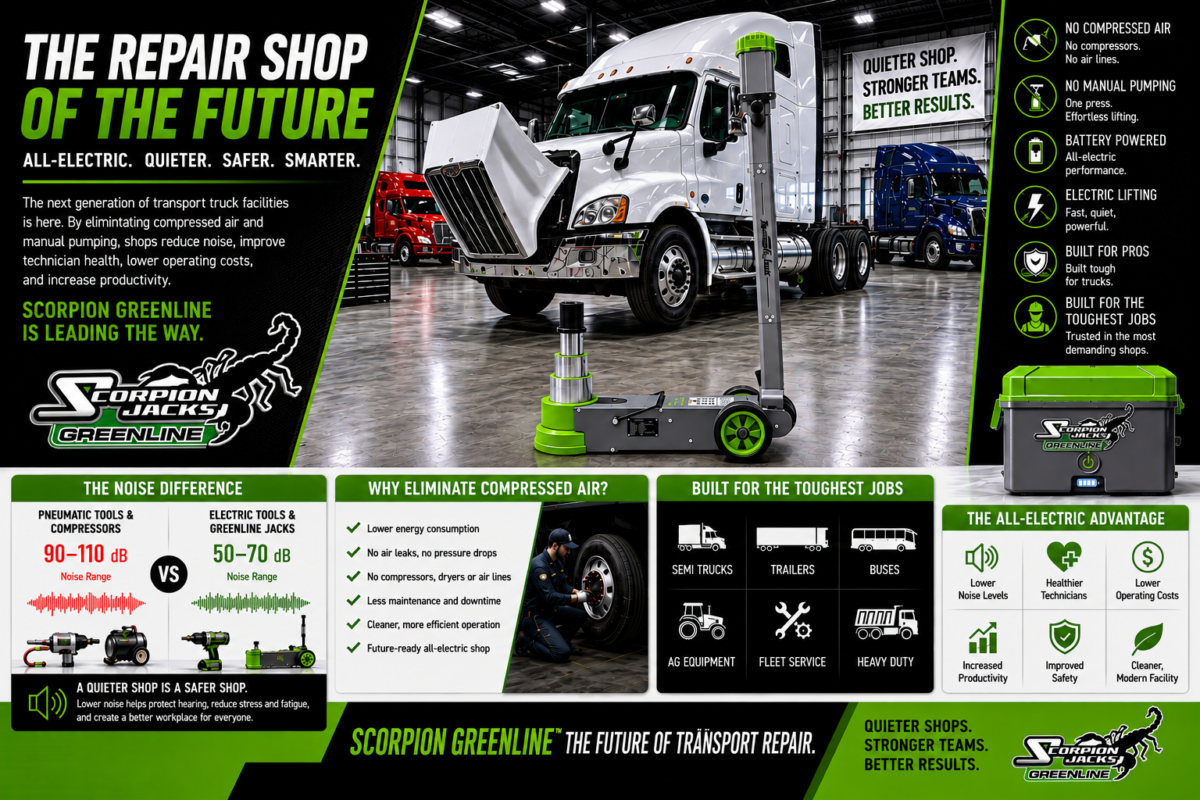
Why the Next Generation Service Facility Will Be All-Electric
Executive Summary
For over 100 years, compressed air has been considered an essential utility in automotive and truck repair facilities. Air compressors power impact wrenches, lifting devices, air ratchets, blow guns, and countless shop operations.
However, what was once considered indispensable is rapidly becoming obsolete.
Advances in battery technology, electric motors, and cordless power tools have created a new opportunity for service facilities: the All-Electric Repair Shop. A shop with no compressors, no air lines, no pneumatic tools, and dramatically reduced workplace noise.
The result is a safer, cleaner, more efficient, and more productive work environment.
The Hidden Cost of Compressed Air
Most repair facilities view compressed air as a necessity, yet it is one of the least efficient forms of energy used in industry.
Compressed air systems require:
- Large capital investment
- Continuous maintenance
- Distribution piping throughout the facility
- Moisture management systems
- Leak detection and repair
- Significant electrical consumption
Even well-maintained systems lose energy through leaks, pressure drops, and inefficient operation.
In many shops, technicians depend on a technology that consumes substantial energy while delivering relatively low efficiency.
Noise: The Occupational Hazard Nobody Talks About
Perhaps the greatest disadvantage of compressed air is noise.
Traditional pneumatic tools commonly generate sound levels between 90 and 110 decibels. Air compressors create additional background noise throughout the workday.
Modern battery-powered tools typically operate in the 50 to 70 decibel range, creating a dramatically quieter work environment.
This difference matters.
Prolonged exposure to elevated noise levels has been linked to:
- Hearing damage
- Worker fatigue
- Reduced concentration
- Increased stress
- Communication difficulties
- Lower job satisfaction
For decades, hearing loss has been viewed as an unavoidable consequence of working in automotive service. Today, that assumption is being challenged.
The Rise of High-Performance Battery Tools
Recent advances in lithium-ion batteries have transformed professional service equipment.
Today’s battery-powered tools deliver performance levels that rival or exceed many pneumatic alternatives.
Technicians now have access to:
- Cordless impact wrenches
- Electric ratchets
- Battery-powered grinders
- Cordless diagnostic equipment
- Mobile lighting systems
- Electric specialty tools
The advantages are significant:
- Reduced noise
- Improved mobility
- No hoses or air lines
- Lower maintenance requirements
- Greater energy efficiency
- Increased technician productivity
Reimagining Vehicle Lifting
While cordless tools have become common, vehicle lifting equipment has remained dependent on manual pumping or compressed air.
This is beginning to change.
The newest generation of electric lifting equipment eliminates the need for manual pumping and compressed air systems.
With the push of a button, technicians can safely lift vehicles while reducing physical strain and improving efficiency.
This represents a major step toward a fully electrified repair facility.
The Scorpion Greenline Approach
Scorpion Greenline was developed around a simple vision:
Create lifting equipment that performs without manual pumping, without compressed air, and without compromising productivity.
By eliminating traditional pneumatic and manual lifting methods, Scorpion Greenline supports the transition toward the all-electric repair shop.
Benefits of the All-Electric Repair Shop
A facility designed around electric tools and equipment delivers measurable advantages:
- Lower noise levels
- Reduced risk of hearing damage
- Improved technician comfort
- Lower energy consumption
- Reduced maintenance costs
- Cleaner work environments
- Greater mobility and flexibility
- Enhanced productivity
- Improved employee retention
Most importantly, it creates a workplace that is better suited for the next generation of technicians.
The Future Is Electric
The repair shop of the future will not simply service electric vehicles.
It will operate using electric tools, electric lifting equipment, intelligent battery systems, and quieter technologies that improve the working environment for everyone.
The transition away from compressed air is more than a technology shift.
It is a shift toward safer workplaces, healthier technicians, lower operating costs, and greater productivity.
The future repair shop is not powered by air.
It is powered by innovation.