
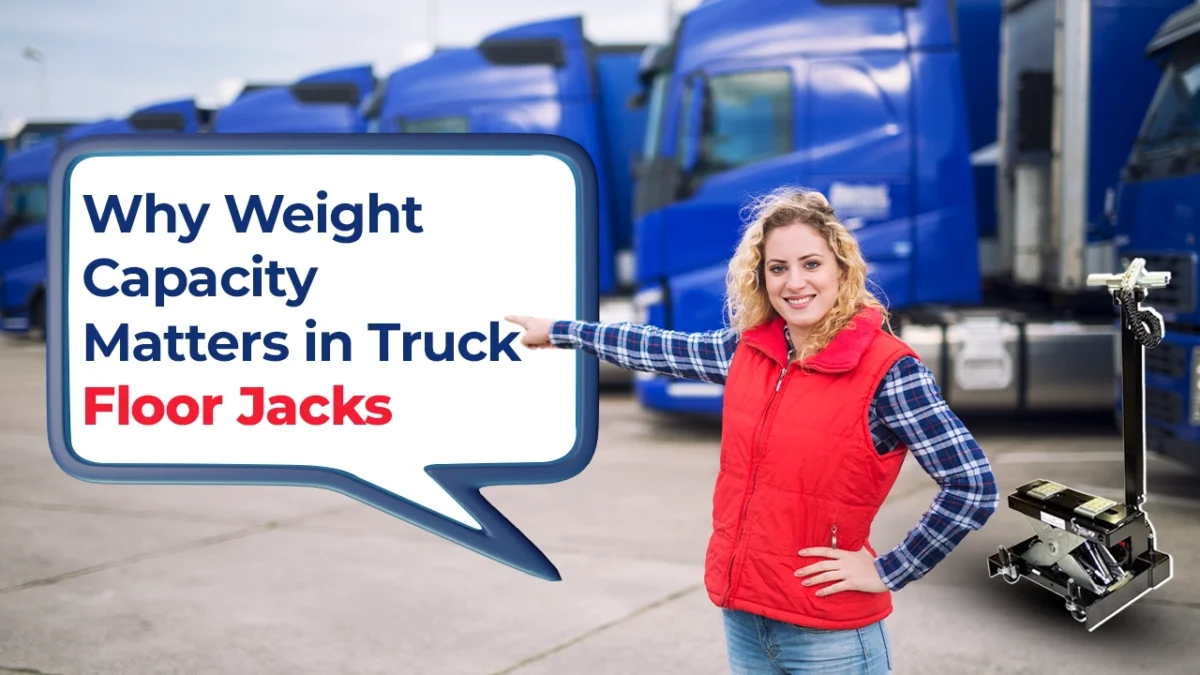
Most truck floor jacks have a weight capacity listed by the manufacturer and are usually listed as a number such as 10-ton, 25-ton, or 50-ton jacks and so on. Typically people will think the more is better scenario.
The weight capacity of a truck floor jack is very important. The capacity of a floor jack can help choose the correct jack for your needs, and how the floor jack will perform in terms of safety and lifting.
For the shop, the truck fleet owner or individual truck owner choosing the correct weight capacity can be the difference between owning a piece of equipment that functions properly and constantly stressing the piece of equipment for poor performance.
What Does Weight Capacity Actually Mean?
Weight capacity refers to the maximum load a floor jack is designed to lift safely.
For example:
- A 10-ton jack is rated for up to 20,000 lbs.
- A 25-ton jack is rated for up to 50,000 lbs.
- A 50-ton jack is rated for up to 100,000 lbs.
That doesn’t mean every truck needs the biggest jack available. The goal is to choose a capacity that matches the vehicles being serviced.
Trucks Are Heavier Than Many People Realize
Passenger vehicles and commercial trucks are in completely different weight categories.
Depending on the application, a workshop may be lifting:
- Pickup trucks
- Delivery vehicles
- Utility trucks
- Fleet vehicles
- Heavy-duty commercial trucks
As vehicle weight increases, the demands placed on the jack increase as well.
That’s why truck floor jacks are built differently from standard automotive floor jacks.
Safety Starts with Proper Capacity
This is probably the biggest reason weight capacity matters.
Using a jack that is too close to its maximum rating every time it’s used isn’t a good habit.
A properly sized jack provides:
- Better stability
- More controlled lifting
- Reduced stress on components
- Greater confidence during operation
Most technicians would rather have some lifting margin than operate right at the limit every day.
Equipment Lasts Longer When It’s Not Overworked
A truck floor jack that constantly operates near its maximum capacity tends to experience more wear over time.
That can affect:
- Hydraulic components
- Seals
- Structural parts
- Overall lifting performance
Choosing the correct capacity helps reduce unnecessary strain and can contribute to a longer service life.
Lifting Speed and Performance Can Be Affected
Many people focus only on whether a jack can lift a vehicle.
But how it lifts matters too.
A properly sized truck floor jack typically:
- Feels more stable
- Lifts more smoothly
- Handles the load more comfortably
When equipment is constantly pushed to its limits, performance often starts to suffer.
Different Shops Need Different Capacities
Not every workshop services the same types of vehicles.
Smaller Commercial Vehicles
A lower-capacity truck floor jack may be perfectly suitable for:
- Light-duty trucks
- Service vans
- Smaller fleet vehicles
Medium-Duty Applications
Shops handling a mix of commercial vehicles often choose mid-range capacities to provide flexibility.
Heavy-Duty Truck Service
Facilities servicing larger commercial trucks usually require higher-capacity equipment designed specifically for heavier loads and repeated daily use.
Bigger Isn’t Always Better
This surprises some buyers.
While it’s important to have enough capacity, buying the largest jack available isn’t always necessary.
Larger-capacity jacks are often:
- Heavier
- More expensive
- Less portable
The goal is to match the equipment to the workload rather than simply choosing the highest number.
One Thing People Often Forget
Weight capacity is important, but it isn’t the only thing worth looking at.
Things like:
- Lift range
- Stability
- Build quality
- Ease of positioning
can have just as much impact on day-to-day use.
A well-built truck floor jack with the right capacity is usually a better choice than an oversized jack that doesn’t fit the workflow.
Choosing the Right Truck Floor Jack
Before deciding on capacity, it’s worth asking a few simple questions:
- What types of trucks are being serviced?
- How often will the jack be used?
- Is portability important?
- Will the jack be used in a workshop or out in the field?
The answers usually make the right capacity much clearer.
Final Thoughts
Weight capacity is one of the main factors to take into consideration when purchasing a truck floor jack. The weight capacity of a floor jack can play a major role in determining the safety, performance, durability and reliability of a product. It is common for consumers to search for the highest weight capacity possible. However, the best floor jack for a consumer’s needs would be a properly rated jack from a quality manufacturer such as Stan Design that has been designed to lift specific amounts of weight and to service various size vehicles on a daily basis.
Workshops including Fleet workshops that depend on their equipment for daily work would be best advised to purchase the correct rated equipment from reputable manufactures like Stan Design, which will last for many years.
Frequently Asked Questions (FAQs)
1. Can I use a higher-capacity truck floor jack than I actually need?
Yes, you can. Just keep in mind that larger-capacity jacks are often heavier and harder to move around.
2. What happens if a jack is too small for the truck?
At best, it won’t lift the vehicle properly. At worst, it can create a serious safety risk.
3. Does a heavier truck always need the biggest jack available?
Not necessarily. The goal is to choose a jack that’s rated appropriately for the vehicles you work on most often.
4. Why do workshops pay so much attention to weight capacity?
Because it affects safety, stability, and how well the equipment performs over time.
5. Is weight capacity more important than lift height?
Both matter. A jack needs enough capacity to lift the load and enough height to reach the required lifting point.
6. Do truck floor jacks wear out faster when lifting near their limit?
They can. Equipment that is constantly pushed close to its maximum rating usually experiences more wear over time.
7. How do I know what capacity truck floor jack I need?
It depends on the type of trucks you service and the amount of weight the jack will regularly be lifting.
8. Is capacity the only thing I should look at before buying?
No. Stability, lift range, build quality, and ease of use are just as important in day-to-day work.