
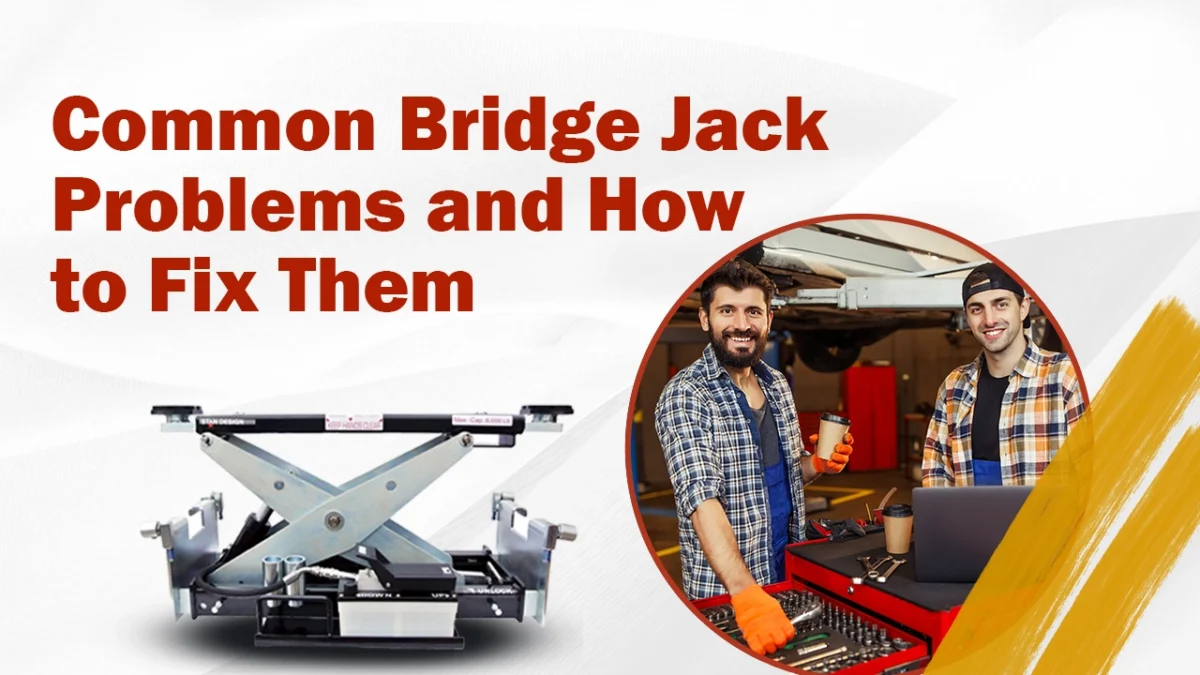
If you’re running a busy auto shop, you’re probably aware that a bridge jack is one of the most essential tools you have. It’s always sitting between the ramps of your four-post lift, taking the full weight of a car every time you need to remove a wheel for things like brake repairs, suspension work, or alignments. Since it gets used all the time, it’s also one of the first things to start showing signs of wear and tear – and when it starts to malfunction, it can really slow down your whole operation.
The good thing is that most problems with bridge jacks are pretty normal and can be fixed easily without having to buy a whole new one. Here, we’ll go over the issues that technicians see most often and exactly how to fix them, so you can keep your shop running smoothly and safely.
1. The Jack Won’t Lift or Loses Lifting Power
This is the number one complaint shop owners bring to us, and it’s almost always tied to the hydraulic system.
Common causes:
- Low or contaminated hydraulic fluid
- Air trapped in the hydraulic lines
- A worn or damaged seal allowing fluid to bypass the piston
- A faulty release valve that isn’t closing fully
How to fix it:
To troubleshoot problems with your mobile lift always start with the simplest thing: the filling level of the fluid. Again and again wrong lubricants are used for mobile lifts, just like for every other application this results in problems with the lift, reduced height of lift or no lift at all. And already after some time the fluid can be dirty, cloudy, milky or even contain other impurities. Then the entire reservoir has to be refilled with new lubricant, often then sudden “loss of lift” occur which cannot be explained.
If fresh fluid doesn’t solve it, bleed the system to remove trapped air. Air pockets compress under pressure instead of transferring force, which makes the jack feel spongy or slow to respond. Finally, inspect the release valve and seals. A valve that won’t seat properly will let fluid bleed back into the reservoir under load, and a worn piston seal will do the same – both need to be replaced rather than patched.
2. Jack Drifts Down Under Load
A bridge jack that slowly lowers on its own after lifting a vehicle is a serious safety issue, not just an inconvenience.
Common causes:
- Internal seal wear allowing fluid to leak past the piston
- A cracked or corroded hydraulic cylinder
- Debris lodged in the check valve, preventing a full seal
How to fix it:
Be sure to use a quality jack to lift your vehicle and support with jack stands rated for the vehicle after it has been lifted. When attempting to diagnose a leak from a hydraulic cylinder look for obvious cracks, pitting or corrosion, especially if the cylinder has ever been exposed to water or snow. If the cylinder appears to be in good shape and is holding pressure, the problem is most likely with the seal kit for the cylinder. Rebuilding the cylinder with a new seal kit is typically far less expensive than replacing the entire cylinder and will return it to full holding pressure. While the cylinder is disassembled be sure to clean the check valve thoroughly as any small metal shavings can keep the check valve from seating properly.
3. Uneven or Unstable Lifting
If a vehicle feels like it’s tilting or rocking as it goes up, that’s a red flag worth stopping for immediately.
Common causes:
- Uneven weight distribution on the jack pad
- Worn rollers or guides that keep the jack aligned on the ramp rails
- A bent or warped lifting arm or platform
- Uneven floor or improperly leveled four-post lift
How to fix it:
First, confirm the vehicle is centered correctly and the load is distributed evenly across the jack’s pads. Next, check the rollers and guide wheels that keep the bridge jack tracking straight along the ramp – worn or flat-spotted rollers are a frequent, easy-to-miss cause of wobble and are inexpensive to replace. Inspect the platform and lifting arms for any visible bending, which can happen after repeatedly overloading the jack beyond its rated capacity. A bent component should be replaced, not straightened, since reshaping steel under load compromises its strength. Finally, double-check that the four-post lift itself is level; a jack can be in perfect condition and still lift unevenly if it’s sitting on an uneven base.
4. Difficulty Rolling or Positioning the Jack
A bridge jack that’s hard to push into place under the vehicle wastes time and adds unnecessary strain for your technicians.
Common causes:
- Worn, flat, or damaged casters and wheels
- Dirt, grease, or debris buildup in the wheel housings
- A bent frame from repeated impacts or overloading
How to fix it:
Clean wheel housings to remove any grime that may have collected on the shop floor whilst the bike was left standing. Lubricate the axles and bearings with the correct grease. Wear on the tire or even cracks within the tire can cause the bike to eventually stop rolling. In these cases the tire will need to be replaced as they are a cheap part, and can get you back on the move in no time. If after sorting the wheels the bike does not move, check the frame for any bends or mis-alignment. A severely damaged frame can cause a jack to pull to one side when attempting to lift the bike.
5. Squeaking, Grinding, or Unusual Noises During Operation
Noise is your bridge jack’s way of telling you something is wearing out before it fails completely.
Common causes:
- Dry or under-lubricated pivot points and bearings
- Worn bushings
- Metal-on-metal contact from a loose or degraded component
How to fix it:
Keep moving parts, hinges and bearings lubricated to avoid the majority of noise complaints. If lubricating does not stop the squeaking, check the bushings for wear. If the bushings are loose or brittle, they will need to be replaced. A grinding noise can indicate serious damage to your equipment such as a broken bearing or part that is rubbing against the frame. This problem needs to be addressed immediately rather than trying to cover up the noise with grease.
6. Jack Won’t Reach Full Height
Common causes:
- Low hydraulic fluid
- Air in the system
- A mechanical stop or safety lock engaged incorrectly
How to fix it:
First, make sure the jack has sufficient lifting capacity by checking the fluid level and bleed the lines if necessary. If for some reason it doesn’t quite reach the rated height, check the mechanical stops and safety locks for operation. If a stop has seized due to rust or debris it will lock up well below the rated lifting height of the jack.
Preventive Maintenance: The Real Fix
Every problem above shares one thing in common – routine maintenance prevents nearly all of them. A consistent maintenance schedule should include:
- Weekly visual inspections for leaks, cracks, or bent components
- Monthly lubrication of all pivot points, bearings, and wheel axles
- Fluid checks to keep hydraulic oil at the correct level and quality
- Load testing to confirm the jack lifts smoothly and holds steady under its rated capacity
- Never exceeding rated capacity, which is the single biggest cause of premature jack failure
Keeping a simple maintenance log for each jack in your shop makes it easy to spot patterns – like a unit that needs fluid more often than others – before they turn into safety hazards or costly downtime.
When to Repair vs. Replace
Most problems with a bridge jack can be fixed in no time with the right spare parts to keep it out of action for a short while. But: a cracked cylinder, severely bent frame or a jack that needs to be repaired too often within a short period of time is better to be replaced by a new, purpose-built bridge jack in the long run than to constantly repair an old one.
Built for the Demands of a Real Shop
At Stan Design, we manufacture high-grade steel bridge jacks engineered specifically for the wear and tear of daily shop use – with lifting capacities up to 25 tons, adjustable widths to fit any four-post lift, and construction built to hold up under constant load. Whether you need a replacement unit or want to explore a custom-designed lifting solution for your bay, our team brings over 25 years of experience building lifting equipment trusted by shops across North America.
If your current bridge jack is giving you more trouble than it’s worth, reach out to Stan Design to find the right fit for your shop.
Frequently Asked Questions (FAQs)
1. How often should I service my bridge jack?
As a general rule, inspect your bridge jack weekly for leaks, cracks, or loose components, and schedule a full lubrication and fluid check monthly. Shops that run jacks multiple times a day should consider more frequent checks, since heavier use accelerates wear on seals, rollers, and bearings.
2. Why does my bridge jack lift unevenly?
Uneven lifting is usually caused by unbalanced vehicle weight on the pads, worn rollers that keep the jack tracking along the ramp, or an unlevel four-post lift. Start by checking vehicle positioning and roller condition before assuming the jack itself is faulty.
3. Is it safe to keep using a jack that drifts down under load??
No. A jack that loses height on its own while supporting a vehicle should be taken out of service immediately and the vehicle placed on rated jack stands. Drifting is typically a sign of worn seals or a damaged cylinder and should be repaired before the jack is used again.
4. What hydraulic fluid should I use in my bridge jack?
Always use the fluid type and viscosity specified by the manufacturer. Using the wrong fluid can cause weak lifting, seal damage, or inconsistent performance, and mixing fluid types can make problems harder to diagnose down the line.
5. Can I repair a bridge jack myself, or do I need a professional?
Many common issues “topping off fluid, bleeding air, greasing pivot points, or replacing worn wheels” can be handled in-house by a shop technician. More involved repairs, like rebuilding a hydraulic cylinder or replacing a bent frame, are best handled by someone experienced with hydraulic lifting equipment to ensure the jack meets safety standards afterward.
6. How do I know if I need to repair my bridge jack or replace it?
If the jack has a cracked cylinder, a bent frame, or has needed multiple repairs in a short window of time, replacement is usually more cost-effective than continuing to patch it. A jack with a single, isolated issue “like worn rollers or a leaking seal” is almost always worth repairing.
7. What’s the lifting capacity of a typical bridge jack?
Capacity varies by model, but shop-grade bridge jacks commonly range up to 25 tons, with adjustable widths designed to fit different four-post lift configurations. Always confirm your jack’s rated capacity and never exceed it, since overloading is one of the leading causes of premature failure.
8. Why is my bridge jack hard to roll into position?
This is usually caused by worn or debris-clogged wheels, dried-out axle grease, or a bent frame from repeated impacts. Cleaning and lubricating the wheel housings resolves most cases; if the jack still pulls to one side afterward, check the frame for misalignment.